Cuando el 13 Bak’tun llegó a su fin el 3 de mayo de 2013, se transmitieron palabras de profecías entre los sabios, guardianes de la tradición: de manera oral se dijo que en ese mismo día de fin del Oxlajun Bak’tun, veríamos la señal del regreso de los grandes sabios en los caminos, gracias a las flores que se abren al mediodía, refiriéndose a la Flor de Mayo. Con esto quedaba descartado que el cierre del 13 Bak’tun hubiera sido el 21 de diciembre de 2012.
El segundo conocimiento provino del Ritual de los Bacabes que aparece en el Chilam Balam de Chumayel: “cuando los extremos del doblez de Katunes se unan”, es decir, cuando se cumplan veinte katunes o cuatrocientos tunes, que son ciclos de 360 k’ines o días, los cuatro bacabes arrasarían la tierra por el levantamiento de Cantul ti ku. Luego de trece años de arrasamiento, se levantarían, uno a uno, los árboles sostenedores del mundo.
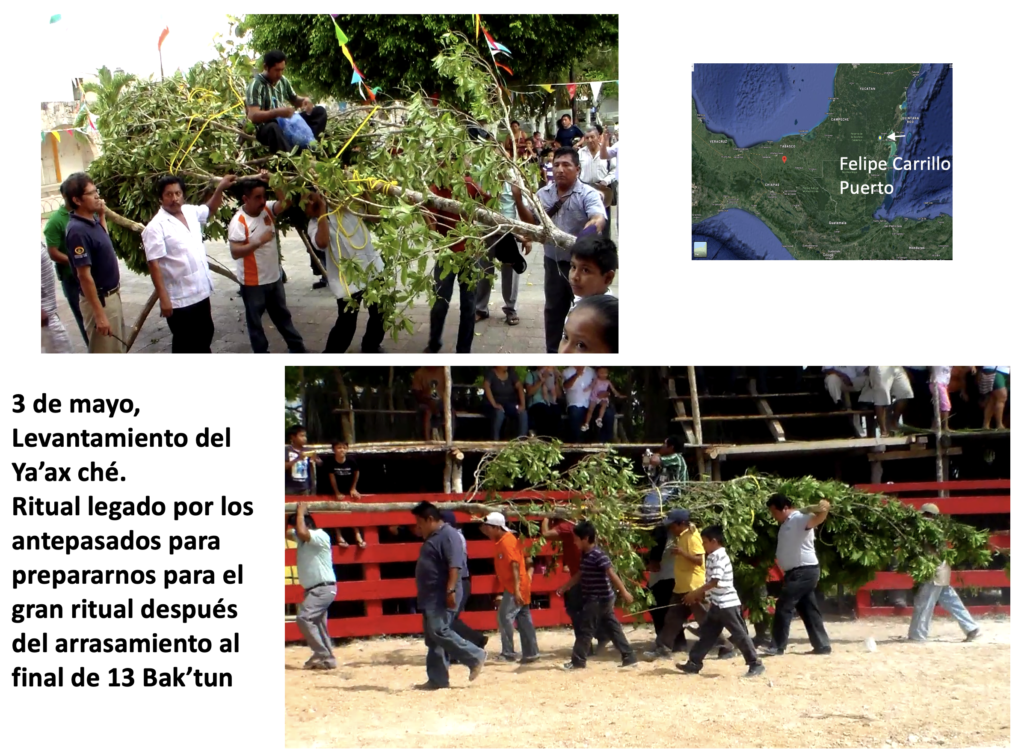
La fecha del levantamiento de los bacabes fue el 3 de mayo de 2026. En Felipe Carrillo Puerto y muchas otras comunidades se llevaron a cabo ceremonias de levantamiento del Yax Ché, la sagrada Ceiba. Estas ceremonias se realizaron con el mismo respeto que hace más de tres mil años, cuando se hicieron en Izapa, Chiapas. Se trata de acto en que se revive el mito que anunció lo que acontecería después del arrasamiento en Oxlajun Bak’tun. Cada vez que se realiza, se reafirma el compromiso de los Hijos del Maíz por mantener el cielo levantado para evitar catástrofes y asegurar que las temporadas de lluvias y de sequía sean benévolas, y dentro de los tiempos normales.
Las ceremonias de levantamiento del Árbol de la Vida son manifestaciones culturales colectivas de reconocimiento al valor ecológico que tienen los ciclos naturales y el rol que cumplen las sociedades en facilitar o distorsionar dichos ciclos. Imagen tomada por el cronista y colega Mario Chan Colli en Felipe Carrillo Puerto.
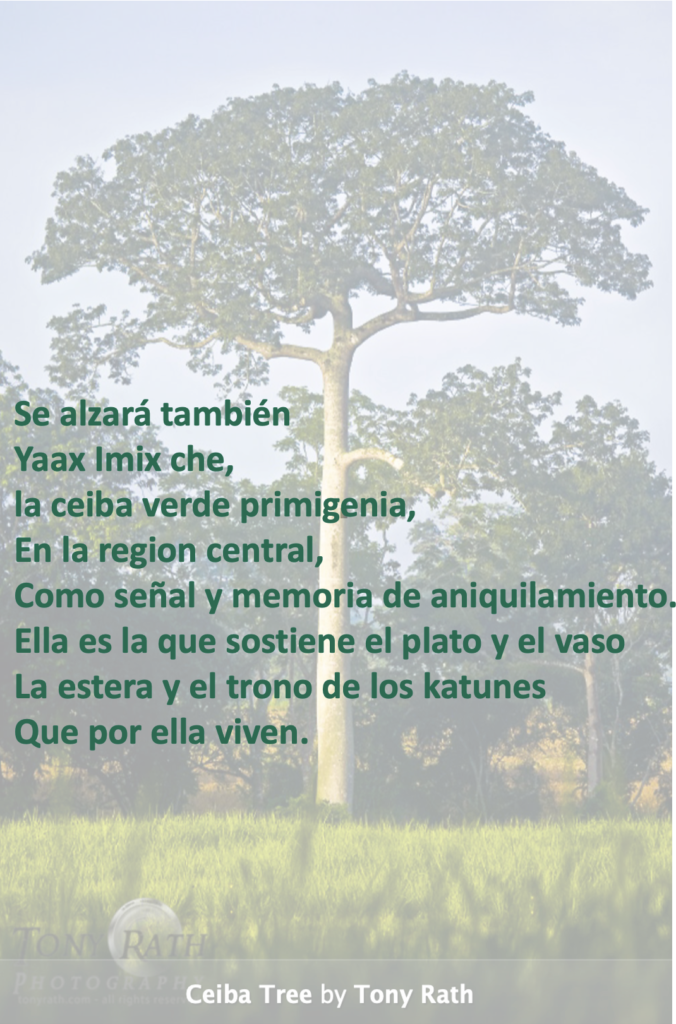
El Ritual de los Bacabes tiene cinco stanzas. La quinta stanza nos recuerda del alzamiento de la ceiba verde primigenia en la región central del mundo, recordándonos que por la estera, por el trono de los katunes (ciclos de veinte tunes) es por lo que vivimos. Extracto del ‘Ritual de los Bacabes’, del Chilam Balam de Chumayel.
Este 3 de mayo de 2026 es una oportunidad para reflexionar profundamente sobre las repercusiones catastróficas en el clima y los ecosistemas por las decisiones que tomen los gobernantes en el presente.
Las lluvias en junio-agosto serán muy intensas debido al calentamiento de las aguas del océano Pacífico, y esto es algo que va a continuar sucediendo durante décadas si continuamos quemando petróleo, practicando el fracking, desviando los cursos de agua, talando los árboles más añosos de los bosques, sembrando monocultivos, minando en el Ártico, la Antártida, en el fondo de los océanos y en las zonas periglaciares y glaciares, así como destruyendo los manglares y los sistemas de lagunas en las zonas costeras.
Tenemos la libertad de discernimiento para crear las condiciones para el Buen Vivir. Seamos dignos antepasados para los que están por nacer. Ellos merecen que les dejemos un mundo más armonioso del que encontramos a nuestro paso.
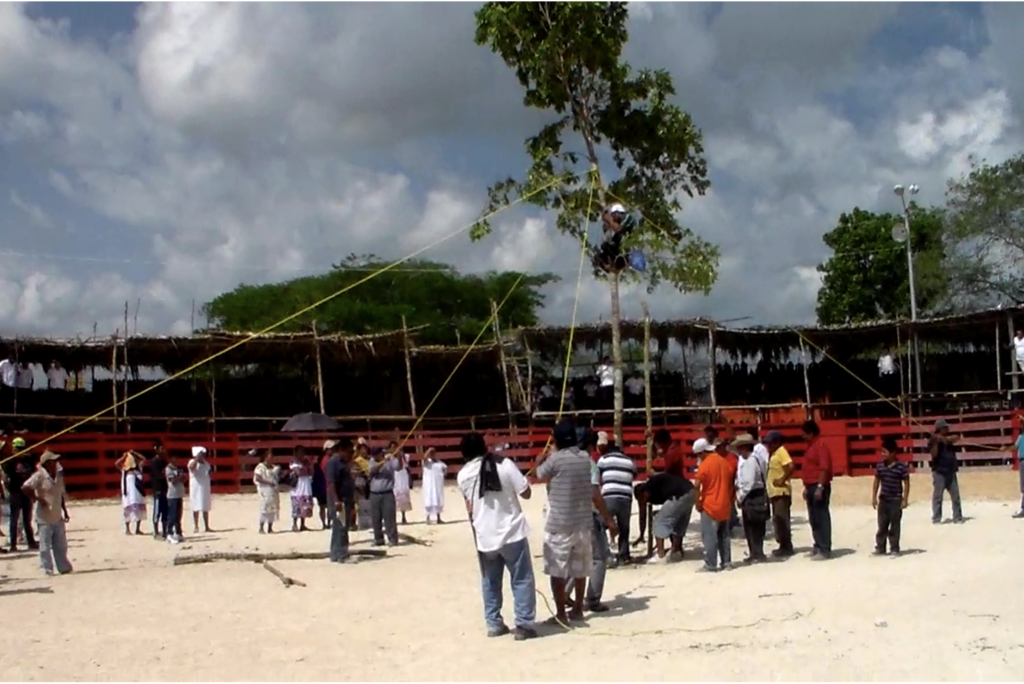
Momento solemne del levantamiento del árbol sagrado que representa a la Yax Ché. Imagen del cronista de Felipe Carrillo Puerto, Mario Chan Colli.
Bienvenidas/os
A medida que incrementa la crisis civilizatoria y planetaria, los pueblos indígenas de todo el mundo, y particularmente del continente del Águila y el Cóndor, nos hemos estado organizando. Nuestros antepasados nos dijeron que debíamos prepararnos para recibir el nuevo tiempo que llegaría con el advenimiento de 2012. El Nuevo Amanecer ya llega.
Nuestra iniciativa es integrar a las autoridades tradicionales, Tatas y Nanas, contadores del tiempo de Turtle Island (Isla Tortuga), Anáhuac-México-Centroamérica, y Tawantinsuyo-Sudamérica. La idea es intercambiar principios, valores y sabiduría ancestral sobre la forma de vida en armonía con los ciclos naturales. Sabemos que en este Nuevo Amanecer nuestro Padre Sol volverá a alumbrarnos. Sabemos que a partir del 3 de mayo de 2026 el mundo estará nuevamente soportado por los cinco árboles en las cuatro esquinas y el centro. Pero ¿qué implica esto en la vida diaria de nuestras comunidades? Sobre todo, ¿cómo planeamos una vida buena cuando la lluvia de temporal se vuelve cada vez más impredecible e irregular, o cuando las iniciativas de desarrollo e inversión atentan contra la tranquilidad de nuestros ecosistemas?
Queremos promover el desarrollo de capacidades organizativas y de liderazgo, un liderazgo que sea balanceado, diverso y unificado. Debemos recibir el Nuevo Amanecer con sabiduría y prácticas adecuadas a los retos climáticos. Por eso aspiramos a que nuestras comunidades puedan fortalecer la resiliencia de sus bioregiones y espacios de producción de alimentos. La base para fortalecer la resiliencia en nuestros territorios consiste en conocer los ciclos y ritmos de la naturaleza. También se requiere conocer el estado de salud de los ecosistemas y las cuencas hidrográficas donde vivimos. Además, debemos conocer los mecanismos para exigir respeto a los derechos de la Madre Tierra y a quienes luchan por defenderla y protegerla.
Vamos a revitalizar el conocimiento práctico de vida en armonía con los ciclos naturales a partir de una visión integrada del tiempo-espacio como lo hicieron los sabios abuelos y abuelas. Saber leer el tiempo y llevar las cuentas nos permitirá estar mejor preparados para los estragos de la crisis climática que se viene con el Nuevo Amanecer.
The Closing of the Fifth Sun in 2012, Eight Years In
By Geraldine Patrick Encina and Mindahi Bastida Muñoz
The year 2012 was filled with expectation, particularly for three groups of people: astronomers, specialists in the cultures of Mexico, and the general public, that developed a fascination for “the end of time” or “the end of the world “.
For astronomers, the focus was on the transit of Venus. From the perspective of an observer on Earth, Venus synodic cycles have a periodicity of 583.92 days. This means that if, for example, the heliacal rising as a morning star is recorded on a certain date, the repetition of this phenomenon will occur in a little over a year and a half.
During the synodic cycle of Venus (Figure 1), Venus is first seen at sunrise over the eastern horizon. Each day it appears at a higher point until, after about five months, it begins to descend. If all the spots where it appears daily were connected, the line would resemble a closed clamp. The journey as morning star takes 263 days (almost nine months). Then Venus becomes invisible because its orbital trajectory is covered by the Sun from our perspective. That trajectory lasts on average 50 days. Then Venus appears for the first time as an evening star, sinking into the western horizon at nightfall. Again, it draws a closed clamp in an average time of 263 days, only this time, it does so in the sunset sky. When no longer visible, Venus is known to be traveling between the Sun and Earth. This journey is 8 days long; then the synodic cycle of Venus begins again.
Figure 1. Two aspects of Venus during a synodic cycle of 584 days. The synodic cycle is the time that goes by for Venus to repeat the same event, as observed from Earth.
Due to the obliqueness of its orbit and ours, the frequency with which Venus gets to transit right in front of the solar disk is very particular: 105.5, 8, 121.5 and 8 years. All other times it passes in front of the solar helium, but not in front of the face of the Sun. The transit implies that Venus can be seen (under ideal conditions of observation of the Sun and with dark, thick lenses) as a mole in front of the Sun, which indicates that Sun-Venus-Earth are aligned.
One such transit occurred in 2004 and could be observed in Asia. Astronomers knew that in 2012 it would be witnessed from Mexico, so the vast majority gathered to see the phenomenon in the same place. I was there, at the Cañada de la Virgen archaeological site, Guanajuato, along with my colleagues from the Archaeoastronomy Seminary (Figure 2). The long-awaited date was June 5, 2012.
Figure 2. Venus transit ‘eclipsing’ the Sun on June 5, 2012. Photo by Ricardo Moyano, taken with a dark lens, in Cañada de la Virgen, Guanajuato.
For their part, the academic specialists in Maya culture were attentive to December 21, 2012, since they had calculated the closure of the great 13 Bak’tun cycle for that date. Both they and Guatemala’s timekeepers participated in costly programs to promote the Maya culture in academic and tourist contexts, giving lectures and producing specialized books and documentaries. In general, they gave little relevant information from the Mesoamerican perspective of astronomy and calendars. That date was not correct, as it was written in stone that the closing of 13 Bak’tun would occur when the evening Venus and the Moon were in the same configuration as at the beginning of the great cycle: both about to emerge from the primordial waters. Metaphorically, they would be ‘birthed’ and at the same time ‘give birth’ to the time-space of the corn people. Such closing of 13 Bak’tun occurred on May 3, 2013, which is 4 Ajaw 3 K’ank’iin on the Ja’ab or Maya year, a year upheld by year-bearer Kaban (Movement), as I have published since 2013.
That evening Venus of May 3, 2013 would emerge from the waters after having acted as a morning star for almost nine months and also spending fifty days of invisibility. Taking into account what the Otomí-Toltec and Maya creation stories tell about the beginning and closing of great cycles, the state of Tlahuizcalpantecuhtli—the impersonator of morning star—must have been comparable to that of a warrior after a battle.
On June 5, 2012, day 10 Rabbit, Tlahuizcalpantecuhtli wearing a Rabbit mask, pierced the Sun with his spear: that was the day of the transit. Five days later, on day 2 Reed, he entered the dawn sky, circumambulating it for almost nine months with bloody hands from the recent execution. After that time, he immersed himself in the primordial waters, an act of purification that allowed him to emerge fifty days later in his evening aspect, now prepared to close the 13 Bak’tun cycle.
So, 2012 was definitely key in the Mesoamerican conception of completion of large cycles, but not for the reasons that scholars of the Maya gave about the closing of 13 Bak’tun on December 21, 2012. In fact, they had no way to prove that date was any different from other December solstices.
The record of the year 2012 was in charge of the Otomí-Toltec astronomer-priests, not of the Maya. It was pre-calculated by them thanks to their observation of Venus and of solar and lunar eclipses —all of which are interpreted as causing endings of times, eras or suns. That calculation was possible due to the knowledge cultivated for hundreds of years in articulation with the so-called ‘Olmecs’, who were inhabitants of the Isthmus of Tehuantepec and speakers of Mixe-Zoque, a language related to Hñahñu-Otomí, Tenek, Cholano and Yucatec Maya. It was from the ‘Olmecs’ that the Maya inherited astronomical knowledge and the calendrical system,[1] noting that May 3 is extremely important, as it is the date when evening star Venus opens the rainy season from its northernmost position on the western horizon.
The Otomí-Toltec astronomer-priests wanted to imprint the date of the closing of the Fifth Sun on the strongest and most durable material available to them: a basaltic megalith of more than twenty-four tons, with a diameter of almost 360 centimeters. The date recorded was 4 Movement of the year 13 Reed, where the sign for 4 Movement is highlighted in Figure 3 in blue and the sign for 13 Reed appears in the red square at the upper end of the stone. The 4 Movement tonal would also occur 260 days later, in Year 1 Flint. For the Otomí-Toltecs, the closing of times have always been in year 13 Reed, which occurs every 52 years and its multiples.
But this particular ending deserved to be recorded in stone to ensure that the population of these times (2012) was prepared for the events caused by 4 Movement —which can be interpreted in association with fire, air, water and earth.
Figure 3. Stone of the Suns. The sign in red in the upper portion records year 13 Carrizo and the sign in blue is tonal Movement, surrounded by four small beads. It is day 4 Movement of year 13 Reed, and it is an Otomí date. The year 1 Flint, also highlighted in red, is the opening year after a 52-year cycle closes in 13 Reed. The tonal 4 Movement happened on March 26, 2012 and 260 days later, on December 11, 2012.[2] On the first date, evening Venus and the Moon were in conjunction. On the second, morning Venus and the Moon were in conjunction. The Venus-Moon conjunction phenomenon denotes eclipse times.
In addition to the two dates 4 Movement, among which visible eclipses would occur in Mesoamerica, another date that stands out on the Stone is 1 Rain of the Otomí year 1 Flint (Figure 4). This date occurred nine days before 10 Rabbit, equivalent to June 5, 2012. We know that up until recently, a nine-day ritual used to be traditionally performed to avoid calamities before the imminent arrival of an eclipse. On day 10 Rabbit Venus eclipsed the Sun. In the interim, the Moon was also eclipsed, on day 8 Death. Five days after 10 Rabbit, [3] Tlahuizcalpantecuhtli appeared in the dawn sky. That date, 2 Reed, shows in the Borgia Codex, p.53, with an omen that coincides with the dramatic closing of the Fifth Sun, for it depicts Tlahuizcalpantecuhtli with a Rabbit mask overthrowing a ruler (see Figures 6 and 8).
Figure 4. Central portion of the Stone of the Suns. The lower date is 1 Rain of the Otomí year 1 Flint (which is equivalent to the Mexica 13 Flint year), and it is translated to May 27, 2012. The Rabbit and Death tonal dates are symbolic. 10 Rabbit alludes to the Rabbit mask worn by Tlahuizcalpantecuhtli in the Borgia Codex for this event.
Pages 53 and 54 of the Borgia Codex (Figures 5 and 6) show an almanac for all dates of heliacal risings of morning Venus for 104 years. In addition, it shows the effects that the rising of the morning star will have in the world: seas and rivers; freshwater mountains; cultivation fields; government structures and among the general population. This almanac shows that Venus observers found that the morning star produces five types of effects, all harmful to life and distinguishable from one another.
Venus experiences five different synodic cycles in an eight-year period. This means that if the first one in the sequence of five synodic cycles is taken as a referent, its repetition will occur after eight years. For example, the cycle that started with the heliacal rising of morning Venus in June 2012 would be repeated in June 2020 and then in 2028, and so on.
Each of the synodic cycles begins at a different time in the solar year. Currently, the five times of the year that see a heliacal rising of morning Venus are: in mid-August, on day or in tonal Cipactli (Crocodile) –see Box 1 of the almanac, Figure 5; at the end of March in tonal Cóatl (Serpent) –Box 2 of Figure 6; at the beginning of November in tonal Atl (Water) –Box 3; in the second week of June in tonal Ácatl (Reed) –Box 4; and in mid-January in tonal Ollin (Movement) –Box 5. The effects of the rising of the morning star are verifiable within a great cycle of 104 years.[4]
Figure 5. Lower left portion of page 54 of the Borgia Codex. This is Box 1 of the Almanac of heliacal risings of morning Venus with omens of the acts by his personification, Tlahuizcalpantecuhtli. This Box 1 is framed by 13 Cipactli (Crocodile) dates which are taken one by one, every eight years. Cipactli is the first tonal of the Tonalpohualli (the 260-day Pan-Mesoamerican cycle). The omen is that Tlahuizcalpantecuhtli with the face of Death will harm beings from the seas, lagoons or rivers. Currently these morning risings of Venus take place in mid-August every eight years.
Figure 6. Page 53 of the Borgia Codex. The reading begins at the bottom, from right to left. Box 2 of the Almanac is for heliacal risings of morning Venus in tonal Cóatl (Serpent). The omen says that the Eagle-headed Tlahuizcalpantecuhtli will hurt the springs. Currently these risings occur at the end of March every eight years. Box 3 is for heliacal risings in tonal Atl (Water). The omen says that Tlahuizcalpantecuhtli with the face of a Dog will cause the cultivating fields to be filled with pests that will attack the corn. Currently these risings occur in early November every eight years. Box 4 is for heliacal risings in tonal Ácatl (Reed). The omen says that Tlahuizcalpantecuhtli with the face of a Rabbit will cause the deposing of rulers. Currently these risings occur in the first weeks of June every eight years. Box 5 is for heliacal risings in tonal Ollin (Movement). The omen says that Tlahuizcalpantecuhtli with the face of Death will provoke war and hunger. Currently these risings take place in mid-January every eight years. Image of Akademische Druk – U. Verlagsanstalt – Graz at famsi.org.
The transit of Venus in front of the solar disk occurred on June 5, 2012 which is 10 Rabbit of the Otomí year 1 Flint. After five days Venus made a first heliacal rising. The date was June 10, 2012, day 2 Reed. According to the almanac on page 53 of the Borgia Codex (Figure 8), this date reveals the burden of overthrowing a ruler, an act carried out by Tlahuizcalpantecuhtli with the face of a Rabbit.
In 2012, this burden was particularly heavy, as the Fifth Sun that ruled for 1040 years was to be terminated. The second half of that cycle, that is, the 520 years between 1492 and 2012, were extremely violent and destructive due to the invasion with the Christian cross and firearms. The closing of the Fifth Sun would certainly bring the unveiling of traumas accumulated by all the generations that have lived in resistance since that bloody 1492. The closing would indeed be stormy and painful, not only for the corn people, but also for the land of their ancestors.
For the Olmec—and later Maya—priest-astronomers, the key moment of closing of the great cycle would be that in which Venus emerged renewed as an evening star (Figure 7). This event would be linked to the birth of the 13 Bak’tun cycle, which was so cherished in Palenque, Yaxchilán, Cobá and Copán—to name a few places. The personified evening Venus was Deity GI (her jadeite face appears in Figure 7), and great Maya rulers—men and women—claimed to come from her lineage only.
Deity GI established order in the world through calendars and ceremonies, instructing corn people to maintain proper behavior, and promising in return copious rains, fertility and continuity of biocultural societies. With birth date 9 Ik’ (9 Wind), it is the same deity that the Otomí-Toltecs called K’eya Maxi, the Mexica called Quetzalcóatl or 9 Ehécatl, and the Itzá called Kukulkán.
May 3 (3 K’ank’iin) is the day that best characterizes the agency of this Pan-Mesoamerican deity, whose rituals are held at the summits of mountains that look to the west. With the deity’s breath of life, that day sees the opening of the season of rain, corn and abundance.
Figure 7. Representation of the trajectory of Venus beginning at the transit date that occurred on June 5, 2012. After five days it made a heliacal rising as a morning star, remaining 263 days in the dawn sky. Then, after being submerged in the primordial sea for fifty days, it emerged renewed on May 3, 2013. This is the narrative that can be read by integrating the Otomí calendrical and astronomical information from the Stone of the Suns and the Maya information from Stela 1 of Cobá and the Tablet of the Cross of Palenque. The jadeite face corresponds to the Deity GI, Venus. On its obverse is marked the date of the beginning of the great cycle of 13 Bak’tun.
The closing moment of 13 Bak’tun, although linked to that beautiful birthing of the corn people, also implied a deep cleansing in every way, materially and spiritually. For thirteen years the Bacabs supporting the world, the five sacred Ceiba or Yaxché trees, would remain fallen. That cleansing would take place mainly in that thirteen-year period.
Every time a Bak’tun is completed (i.e. 400 Tunes of 360 days) the same happens. While the Bacabs are down, all kinds of calamities occur. In the Chilam Balam of Chumayel we read these verses from the Ritual of the Bacabs:
In these stanzas we note that the agent of destruction is Bolón ti ku. It is the same Bolon Yokte’ K’uh that, around 650 C.E., was invoked by the ruler of Tortuguero, Tabasco, who was seeing prolonged droughts and famines impacting the territory at the time. [5]
Bolon Yokte’ K’uh is the personification of planet Mars, and it is a deity that calls for violent destruction. It is important to note that that ruler, Bahlam Ajaw, pointed out that, upon the completion of 13 Bak’tun, we would witness Bolon Yokte’ K’uh “in his great investiture ”, while making no allusion to the resurgence of evening Venus. Certainly, Mars emerged in the dawn sky on May 3, 2013. But why did Bahlam Ajaw choose to resort to the auspices of Mars, plundering in his name, while his Palenque relatives remained loyal to Deity GI, evening Venus? Why, if his relatives’ vision was one of evening Venus emerging from the primordial waters once again at the closing of 13 Bak’tun, Bahlam Ajaw instead exalted Mars’s rising? One path and philosophy of life is that of Palenque peoples, who honor 9 Ik ’, Venus, the breath of life, the rain bringer and the fertilizer of corn. It is the kind of thinking that relies on the re-harmonization of the world after thirteen years of experiencing unsettling agitation and shifting of forces while the Bacabs remain fallen. The other way is to take up arms, annihilate the defenseless and loot to survive while better times come.
Today—and exactly on November 3, 2019—we have gone through half of the 13-year cycle in which the Bacabs remain fallen. These are the most critical times, in which all kinds of disasters and distress combine in nature and in our society. You can review what has been going on, from the recent locust plague in North Africa, to the intercontinental invasion of killer wasps, and to the bat-borne coronavirus in China. Earthquakes, volcanic eruptions, hurricanes and melting of the polar icecaps and glaciers in the summits are becoming increasingly frequent and intense.
But none of this is just of natural cause. The ancestors did not record what would happen each time the Bacabs fall so to accept a fatal predestination. On the contrary, they recorded it so that biocultural societies could contribute to maintaining a high resilience of ecological and socio-ecological systems. By maintaining that resilience, damage from natural impacts would be reduced. Likewise, when the time of the falling of the Bacabs came, there would be an opportunity to make a review of consciousness and a rectification of the behaviors that threaten the harmonious continuity of life.
The destruction we are now witnessing is the result of the execution of the mandate to dominate nature and exterminate native peoples —those who have developed a responsible way of life with the land, understanding their purpose of caring for life, a mandate of Mother Earth’s. Modern societies continue to reproduce the acts of oppression and domination ordered in 1493 —and even half a century earlier— by two popes that deserve no mention. They are acts at the micro and macro scale that affect the individual and collective psyche, and that are based on the principle of free will and the belief in Christian salvation. Laws and rules are written by common agreement of a group of interest, but that interest is avaricious, and the rules can be violated at any time.
Instead, the original societies are organized based on the mandates of Mother Earth to care for the germs and sources of life. There is no free will at all. One lives—both in the world of life and of dreams, and in that of the spirits of plants and animals and of the dead—with the awareness that all thought and act become a germ and principle of life and regeneration. It cannot be otherwise, or there will be dire consequences.
Almanacs, carved stones, pyramids and ceremonial centers, bequeathed by the Otomí-Toltec and Maya cultures, integrated a system of coordination with Mother Earth and celestial bodies, a guideline for thought and action. Every act must be previously consulted: the germ of thought must be presented before the table or the altar of the family house. This table represents the generosity, abundance and unconditional love of Mother Earth, as well as her all-encompassing consciousness, in which ours expands.
The biggest problem among ‘modernized’ native populations is demeaning the ability of foremothers and fathers to interpret nature’s signs, and not being able to read and interpret almanacs anymore. It is our responsibility to cultivate knowledge and perform traditional ceremonies, as well as to agree to and enforce laws based on the mandates of Mother Earth. Along with allies with open minds to listen to and respect the wisdom of Peoples, the vast majority of society—already emancipated from patriarchy—has an immense responsibility to prevent disasters from having such destructive effects that there may no longer be an opportunity for ecosystems and biomes to regenerate.
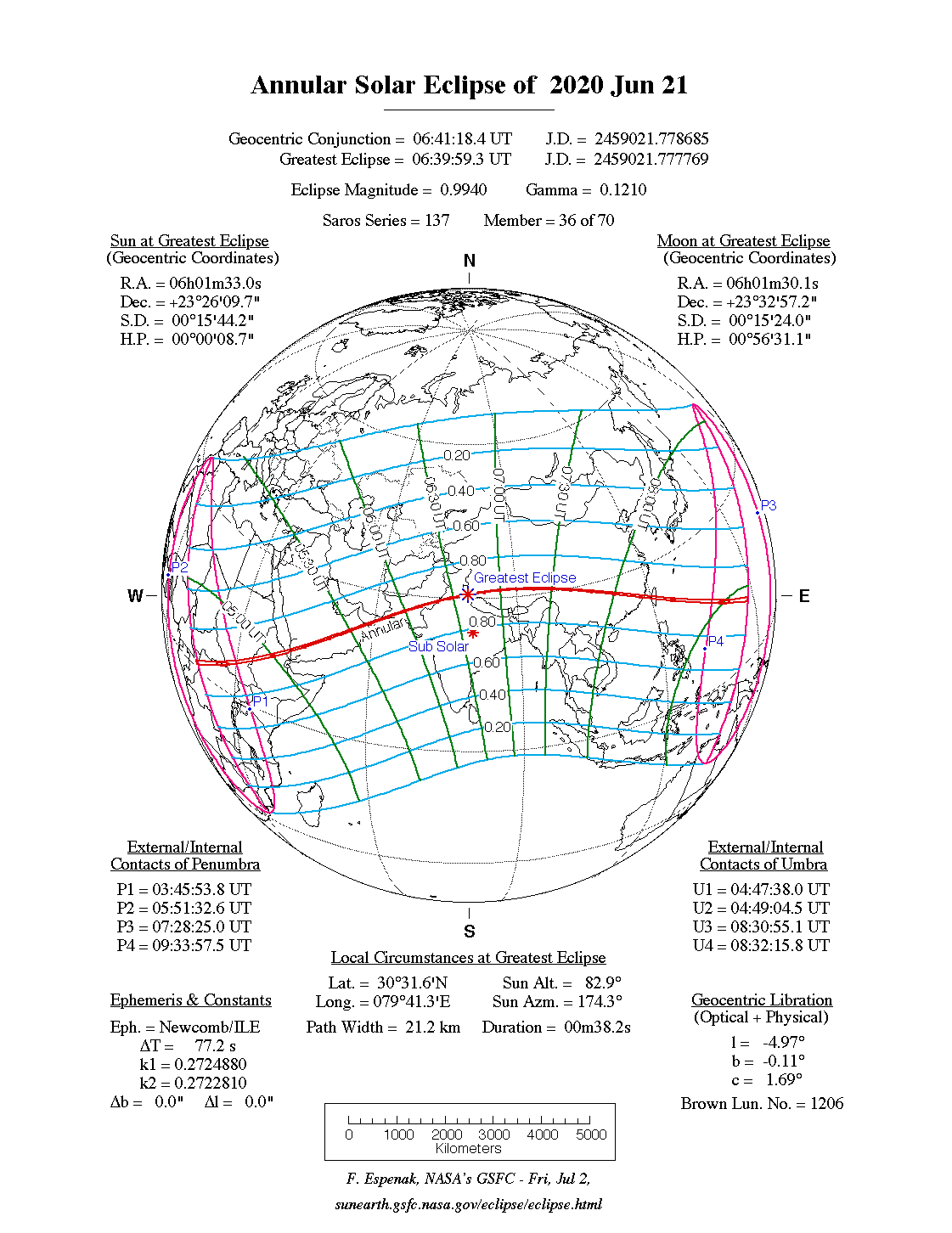
On June 5, 2020 we are living an entire eight-year cycle of Venus with the same effects as those brought about by the transit of Venus in 2012. Due to the lack of an ethical and civil attitude at the height of the teachings of the ancestors for the care of life, the effects are being much more serious than in 2012. Furthermore, the phenomenon of the Moon eclipsed on the same June 5, 2020 has come to exacerbate the way in which conflicts are perceived and responded to. Even more, the eclipse of the Sun on June 21 will also affect, particularly because the relation of the Earth with the Sun will be one of maximum separation, and they will be aligned not only with the Moon, but with several planets. These are ideal conditions for earthquakes.
Those who head institutions that have allowed the outcome of disasters (contaminated waters, lack of water, hunger, plagues and civil confrontations) to states of irreversibility will be removed (Figure 8). Such is the forecast for the Morning Venus Almanac of the Otomí and Mexica presented here.
Everything we are experiencing would have been avoided if the orders of domination, extermination and evangelization had been suspended; if the impulse of war and violence did not exist; if the Aristotelian object-subject binomial had been discarded; if the Cartesian methods of variable control had been ruled out. Everything we are about to live will depend on the collective human dignity to put a stop to the institutions that do not work to ensure a harmonious living with Earth.
Figure 8. Table 4 of the Morning Venus Almanac, page 53 of the Borgia Codex. The omen is for all dates that are separated by eight years, on which morning Venus rises on day Ácatl. On June 10, 2012, when morning Venus dawned, it was 2 Ácatl (box in red). The omen was misfortune and the end of rulers. Eight years later, on June 10, 2020, morning Venus dawns on day 10 Ácatl (box in blue). The omen is reiterated: misfortune and end of rulers.
The time has come to renew the contract with Mother Earth, to once again adopt her mandate. Only in this way will Bacabs, the supporting trees of the sky and the earth, stand up and bring a sense of biocultural harmony once again. Our consciousness and energies must come together to prepare for the ceremony to be held at the rising of the five Bacabs on May 3, 2026. There are Maya communities who have been rehearsing this ceremony for thousands of years. Our responsibility is that it be done with all the protocol and due respect to the ancient tradition.
It is a task that is based on the Unification Process, where the agencies of communities, nature, institutions and the cosmos unite in the purpose of caring for life, guided by the law of origin, the law of nature and the law of Mother Earth.
[1] This knowledge was applied by the Maya between the pre-Classic (600 B.C.) and the Terminal Classic (around 1,100 B.C.), retaining some of the elements until around 1820, as can be seen in historical documents of the Yucatan Peninsula.
[2] Both dates were recorded for year 1544 (also a year 13 Reed – 1 Flint) by Friar Diego Durán (Durán 1570; 1967, Vol. I:105).
[3] The five counted days are: 11 Water, 12 Dog, 13 Monkey, 1 Grass, 2 Reed.
[4] After this time the almanac is recalibrated, since the heliacal risings of Venus occur a month earlier when compared to those of 104 years ago.
[5] Kennett, D.J. et al. (2012) “Development and Disintegration of Maya Political Systems in Response to Climate Change.” Science, Vol. 338, No. 6108, pp.788-791, 9 November 2012. The authors propose “that anomalously high rainfall favored unprecedented population expansion and the proliferation of political centers between 400 and 600 C.E. This was followed by a drying trend between 600 and 1000 C.E. that triggered the balkanization of polities, followed, followed by population by population collapse in the context of an extended drought between 1020 and 110 C.E.”
El Cierre del Quinto Sol en 2012. Ocho Años Después
Por Geraldine Patrick Encina y Mindahi Bastida Munoz
El año 2012 estuvo lleno de expectación, particularmente para tres grupos de personas, los astrónomos, los especialistas en las culturas de México, y el público en general que había desarrollado una fascinación por “el fin de los tiempos” o “el fin del mundo”.
Para los astrónomos, la atención estaba puesta en el tránsito de Venus. Desde la perspectiva de un observador en la Tierra, Venus realiza un ciclo sinódico cada 583.92 días. Esto significa que, si por ejemplo, se registra la fecha en que hizo su primer amanecer como estrella matutina, la repetición de este fenómeno se dará dentro de un poco más de año y medio.
Durante el ciclo sinódico de Venus (Figura 1), primero se aprecia a Venus del amanecer sobre el horizonte oriente. Cada día aparece en un punto más elevado hasta que, luego de unos cinco meses, comienza a descender. Si se juntaran todos los puntos en que aparece a diario, el dibujo semejaría una pinza cerrada. El recorrido en su aspecto de lucero del alba demora 263 días (casi nueve meses). Luego Venus deja de verse porque su trayectoria orbital va por detrás del Sol desde nuestra perspectiva. Esa trayectoria dura en promedio 50 días. Luego Venus se asoma por primera vez como lucero del atardecer, hundiéndose en el horizonte poniente al caer la noche. Nuevamente dibuja una pinza cerrada en un tiempo promedio de 263 días, sólo que esta vez, en el cielo del ocaso. Al dejar de verse, se sabe que Venus está viajando entre el Sol y la Tierra. Este trayecto es de 8 días; luego, el ciclo sinódico de Venus comienza otra vez.
Figura 1. Dos aspectos de Venus durante un ciclo sinódico de 584 días. El ciclo sinódico es el tiempo que transcurre para que Venus repita un mismo evento, verificable desde La Tierra.
Debido a la oblicuidad de su órbita y de la nuestra, la frecuencia con que Venus llega a transitar justamente frente al disco solar es muy particular:105.5, 8, 121.5 y 8 años. Todas las demás veces pasa frente al helio solar, mas no frente a la cara misma del Sol. El tránsito implica que Venus se llega a ver (bajo condiciones ideales de observación del Sol y con prismas gruesos y obscuros) como un lunar frente al Sol, lo cual indica que los cuerpos celestes Sol-Venus-Tierra están alineados.
Uno de tales tránsitos sucedió en el año 2004 y pudo ser observado en Asia. Los astrónomos sabían que en 2012 se presenciaría desde México, por lo que la gran mayoría se reunió para ver el fenómeno en un mismo lugar. Yo estuve allí, en el sitio arqueológico Cañada de la Virgen, Guanajuato, junto a mis colegas del Seminario de Arqueoastronomía (Figura 2). La tan esperada fecha fue el 5 de junio de 2012.
Figura 2. Tránsito de Venus ‘eclipsando’ al Sol el 5 de junio de 2012. Foto de Ricardo Moyano, tomada con una lente obscura, en Cañada de la Virgen, Guanajuato.
Por su parte, los académicos especialistas en la cultura maya estaban atentos al 21 de diciembre de 2012, pues habían calculado el cierre del gran ciclo 13 Bak’tun para esa fecha. Tanto ellos como los contadores del tiempo en Guatemala diseñaron por años costosos programas de promoción de la cultura maya en ámbitos académicos y turísticos, impartiendo conferencias y produciendo libros y documentales especializados. En general, dieron información poco relevante desde la perspectiva mesoamericana de astronomía y calendarios. Aquella fecha no era la correcta, pues estaba escrito en piedra que el cierre ocurriría cuando Venus vespertino y la Luna estuvieran en la misma configuración que al comienzo del gran ciclo: ambos a punto de emerger de las aguas primordiales. Metafóricamente, serían alumbrados y a la vez alumbrarían al tiempo-espacio de la gente del maíz. Tal cierre de 13 Bak’tun se dio el 3 de mayo de 2013, en fecha 4 Ajaw 3 K’ank’iin del Ja’ab o año maya, un año cargado por Kaban (Movimiento), como he publicado desde 2013.
Aquel Venus vespertino del 3 de mayo de 2013 emergería de las aguas después de haber actuado como estrella matutina por casi nueve meses y luego pasar cincuenta días de invisibilidad. Tomando en consideración lo que narran las historias de creación otomí-toltecas y mayas en cuanto al inicio y cierre de grandes ciclos, el estado de Tlahuizcalpantecuhtli—el que personifica a la estrella matutina—debe haber sido equiparable al de un guerrero después de una batalla.
El 5 de junio de 2012, día 10 Conejo, Tlahuizcalpantecuhtli con cabeza de Conejo atravesó al Sol con su lanza: ése fue el día del tránsito. Cinco días después, en día 2 Carrizo, ingresó a ocupar el cielo del amanecer (Figura 8), recorriéndolo durante casi nueve meses con las manos ensangrentadas por la reciente ejecución. Después de ese tiempo se sumergió en las aguas primordiales, un acto de purificación que le permitió emerger en su aspecto vespertino para poder cerrar el ciclo 13 Bak’tun.
Así es que el 2012 definitivamente fue clave en la conceptuación mesoamericana de cierre de grandes ciclos, pero no por las explicaciones que dieron los mayistas sobre el término de 13 Bak’tun en 21 de diciembre de 2012. En realidad, no tuvieron manera de probar que aquella fecha fuera distinta a otros solsticios de diciembre.
El registro del año 2012 estuvo a cargo de los astrónomos-sacerdotes otomí-toltecas, no de los mayas. Fue pre-calculado por ellos gracias a su observación de Venus y de eclipses solares y lunares—fenómenos todos interpretados como causantes de terminación de tiempos, eras o soles. Aquel cálculo fue posible por los conocimientos cultivados durante cientos de años en articulación con los llamados ‘olmecas’, habitantes de la región del Istmo de Tehuantepec y hablantes del mixe-zoque, una lengua emparentada con el hñahñu-otomí, el tének, el cholano y el maya yucateco. Fue de los ‘olmecas’ que los mayas heredaron el conocimiento astronómico y el sistema calendárico[1], notando que el 3 de mayo es importantísimo por ser la fecha en que Venus vespertino abre la temporada de lluvias desde su posición más al norte sobre el horizonte del poniente.
Los astrónomos-sacerdotes otomí-toltecas quisieron imprimir la fecha del cierre del Quinto Sol sobre el material más firme y duradero a su alcance: un megalito basáltico de más de veinticuatro toneladas, con un diámetro de casi 360 centímetros. La fecha registrada fue 4 Movimiento del año 13 Carrizo, donde el signo para 4 Movimiento se destaca en la Figura 3 en azul y el signo para 13 Carrizo aparece en el cuadrete rojo en el extremo superior de la piedra. El tonal 4 Movimiento también ocurriría 260 días después, en el año 1 Pedernal. Para los otomí-toltecas, los cierres de tiempo siempre han sido en año 13 Carrizo, lo cual acontece cada 52 años y sus múltiplos.
Pero este cierre en particular merecía ser registrado en piedra para asegurar que la población de estos tiempos (2012) estuviera preparada para los acontecimientos provocados por los 4 Movimientos –lo cual puede interpretarse en asociación con el fuego, el aire, el agua y la tierra.
Figura 3. Piedra de los Soles. El cuadrete de año en rojo en la porción superior registra el año 13 Carrizo y el signo en azul es el tonal Movimiento que va acompañado de cuatro chalchihuites. Así se especifica que se trata del tonal 4 Movimiento del año 13 Carrizo. Esta es una fecha otomí. El año 1 Pedernal también se destaca en rojo porque es el año que ingresa al cerrarse un ciclo de 52 años en 13 Carrizo. El tonal 4 Movimiento sucedió el 26 de marzo de 2012 y 260 días después, el 11 de diciembre de 2012 [2]. En la primera fecha, Venus vespertino y la Luna estuvieron en conjunción. En la segunda, Venus matutino y la Luna estuvieron en conjunción. El fenómeno de conjunción Venus-Luna denota época de eclipses.Además de las dos fechas 4 Movimiento, entre las cuales sucederían eclipses visibles en Mesoamérica, destaca en la Piedra la fecha 1 Lluvia del año otomí 1 Pedernal (Figura 4). Esta fecha ocurrió nueve días antes de 10 Conejo, equivalente al 5 de Junio de 2012. Una novena es el tiempo en que se han de hacer rituales para evitar calamidades ante la inminente llegada de un eclipse. En 10 Conejo Venus eclipsó al Sol. En el inter, la Luna fue eclipsada también, en día 8 Muerte. Pasando 10 Conejo, cinco días después, surgió Tlahuizcalpantecuhtli en el cielo del alba. Esa fecha, 2 Carrizo, aparece en el Códice Borgia, p.53, con un augurio que coincide con el dramático cierre del Quinto Sol porque se trata de Tlahuizcalpantecuhtli con cabeza de Conejo derrocando a un gobernante (ver Figuras 6 y 8).
Figura 4. Porción central de la Piedra del Sol. La fecha inferior es 1 Lluvia del año otomí 1 Pedernal (que equivale al año mexica 13 Pedernal), y se traduce al 27 de mayo de 2012. Las fechas tonales Conejo y Muerte son simbólicas. 10 Conejo alude al aspecto de Conejo que presenta Tlahuizcalpantecuhtli en el Códice Borgia para este evento.
Las páginas 53 y 54 del Códice Borgia (Figuras 5 y 6) presentan un almanaque con registros de todas las fechas de salidas heliacas de Venus matutino durante 104 años. Además, muestra los efectos que ejercerá la estrella matutina en el mundo: en los mares y ríos; en las montañas de agua dulce; en los campos de cultivo; en las estructuras de gobierno y en la población en general. Este almanaque muestra que los observadores de Venus constataron que la estrella matutina produce cinco tipos de efectos, todos nocivos para la vida y todos distinguibles entre si.
Venus experimenta cinco ciclos sinódicos distintos en un periodo de ocho años. Esto significa que, si se toma el primero en la secuencia de cinco ciclos sinódicos, su repetición ocurrirá hasta dentro de ocho años. Por ejemplo, el ciclo que comenzó con la salida heliaca de Venus matutino en junio de 2012 se ha de repetir en junio de 2020 y luego en 2028, y así sucesivamente.
Cada uno de los ciclos sinódicos comienza en un momento distinto del año solar. En la actualidad, los cinco momentos del año para una salida helíaca de Venus matutino son: a mediados de agosto, en día o tonal Cipactli (Cocodrila) –ver el Cuadro 1 del almanaque, Figura 5; a fines de marzo en tonal Cóatl (Serpiente) –Cuadro 2 de la Figura 6. A principios de noviembre en tonal Atl (Agua) –Cuadro 3. En la segunda semana de junio en día Acatl (Carrizo) –Cuadro 4. Y a mediados de eneroen tonal Ollin (Movimiento) –Cuadro 5. Los efectos de la salida de la estrella matutina son comprobables dentro de un gran ciclo de 104 años.[3]
Figura 5. Porción inferior izquierda de la página 54 del Códice Borgia. Se trata del Cuadro 1 del Almanaque de salidas heliacas de Venus matutino con augurios sobre el modo en que habrá de actuar Tlahuizcalpantecuhtli, su personificación. Este Cuadro 1 está enmarcado por 13 fechas Cipactli (Cocodrila) las cuales se van dando una a una, cada ocho años. Cipactli es el primer tonal del Tonalpohualli (el ciclo panmesoamericano de 260 días). El augurio es que Tlahuizcalpantecuhtli con cara de Muerte hará daño a los seres de los mares, lagunas o ríos. Actualmente se trata de las salidas que se dan a mediados de agosto cada ocho años.
Figura 6. Página 53 del Códice Borgia. La lectura se da desde abajo, de derecha a izquierda. Cuadro 2 del Almanaque para salidas heliacas en fecha o tonal Cóatl (Serpiente). El augurio dice que Tlahuizcalpantecuhtli con cabeza de Águila lastimará los manantiales. Actualmente se trata de las salidas que ocurren a fines de marzo cada ocho años. Cuadro 3 para salidas heliacas en fecha o tonal Atl (Agua). El augurio dice que Tlahuizcalpantecuhtli con cabeza de Perro hará que las tierras se llenen de pestes que atacarán al maíz. Actualmente se trata de las salidas que ocurren a principios de noviembre cada ocho años. Cuadro 4 para salidas heliacas en tonal Acatl (Carrizo). El augurio dice que Tlahuizcalpantecuhtli con cara de Conejo hará que los gobernantes sean destituidos fulminantemente. Actualmente se trata de las salidas que se dan en las primeras semanas de junio cada ocho años. Cuadro 5 para salidas heliacas en tonal Ollin (Movimiento). El augurio dice que Tlahuizcalpantecuhtli con cara de Muerte provocará guerra y hambre. Actualmente se trata de las salidas que se dan a mediados de enero cada ocho años. Imagen de Akademische Druk – U. Verlagsanstalt – Graz en famsi.org.
El tránsito de Venus frente al disco solar aconteció el 5 de junio de 2012 o 10 Conejo del año otomí 1 Pedernal. Al cabo de cinco días[4] Venus hizo su primera salida heliaca. La fecha fue 10 de junio de 2012, día 2 Carrizo. De acuerdo con el almanaque en la página 53 del Códice Borgia (Figura 8), esta fecha trae la carga propia del acto de derrocamiento de un gobernante, acto ejecutado por Tlahuizcalpantecuhtli con faz de Conejo.
En el año de 2012, dicha carga fue particularmente pesada, pues se estaba dando término al Quinto Sol que gobernó durante 1040 años. La segunda mitad de aquel ciclo, o sea, los 520 años entre 1492 y 2012, fueron extremadamente violentos y destructivos a causa de la invasión con el arcabuz y la cruz. De modo que el cierre del Quinto Sol traería consigo el develamiento de traumas acumulados por todas las generaciones que han vivido en resistencia desde aquel sangriento 1492. El cierre sería, en verdad, tormentoso y doloroso, no sólo para la gente del maíz, sino también para la tierra de sus ancestros.
Para los sacerdotes-astrónomos olmecas—y luego mayas—, el momento clave de cierre de un gran ciclo habría de ser aquel en que Venus emergiera renovado como estrella vespertina (Figura 7). Este acontecimiento tendría la carga del nacimiento del ciclo 13 Bak’tun, mismo que fuera bellamente recordado y plasmado en estelas de Palenque, Yaxchilán, Cobá y Copán—por mencionar algunos sitios. La personificación de Venus vespertino se dio principalmente por medio de la Deidad GI (su cara en jade aparece en la Figura 7)—de cuyo linaje provinieron grandes gobernantes mayas, hombres y mujeres.
La Deidad GI instauró orden en el mundo por medio de los calendarios y las ceremonias, instruyendo a los hombres y mujeres del maíz a mantener un comportamiento apropiado, prometiendo a cambio copiosas lluvias, fertilidad y continuidad de las sociedades bioculturales. Su nacimiento fue el día 9 Ik’ (9 Viento), de manera que se trata de la misma deidad que lleva por nombre K’eya Maxi entre los otomí-toltecas, Quetzalcóatl o 9-Ehécatl entre los mexica, y Kukulkán entre los itzaes.
El 3 de mayo (3 K’ank’iin) es el día que mejor caracteriza la agencia de esta deidad panmesoamericana, celebrada en las cumbres que miran al poniente. Con su aliento de vida, abre en ese día la temporada de la lluvia, el maíz y la abundancia.
Figura 7. Representación de la trayectoria de Venus desde la fecha de tránsito ocurrida el 5 de junio de 2012. A los cinco días hizo una salida heliaca como estrella matutina permaneciendo 263 días en ese estado. Luego, tras sumergirse en el mar primordial por cincuenta días, emergió renovado el 3 de mayo de 2013. Esta es la narrativa que puede leerse al integrar la información calendárica y astronómica otomí de la Piedra del Sol y la maya de la estela 1 de Cobá y del Tablero de la Cruz de Palenque. La cara de jadeíta corresponde a la Deidad GI, Venus. En su anverso se marca la fecha del comienzo del gran ciclo de 13 Bak’tun.
El momento de cierre de 13 Bak’tun, si bien ligado a aquel hermoso nacimiento del ciclo de la civilización del binomio humano-maíz, implicaba una profunda limpieza en todos los sentidos, material y espiritualmente. Durante trece años los Bacabes sostenedores del mundo, sagradas ceibas o Yaxché, permanecerían caídos. Aquella limpieza acontecería principalmente en ese periodo de trece años.
Cada vez que se completa un Bak’tun (400 Tunes de 360 días) sucede lo mismo. Mientras los Bacabes están caídos ocurre todo tipo de calamidades. En el Chilam Balam de Chumayel leemos estos versos del Ritual de los Bacabes:
En estas estrofas notamos que el agente de destrucción es Bolón ti ku. Se trata del mismo Bolon Yokte’ K’uhque, hacia el año 650 n.e., fuera invocado por el gobernante de Tortuguero, Tabasco, desesperado por las prolongadas sequías y hambrunas que estaban impactando el territorio en aquellos tiempos.[5] Bolon Yokte’ K’uh es la personificación del planeta Marte, una deidad que insta a la destrucción con violencia. Resulta importante notar que aquel gobernante, Bahlam Ajaw, señaló que, al completarse 13 Bak’tun, presenciaríamos a Bolon Yokte’ K’uh “en su gran investidura”, y desconoció totalmente el resurgir de Venus vespertino. Ciertamente, Marte emergió en el cielo del amanecer a partir del 3 de mayo de 2013. Pero ¿por qué optaba Bahlam Ajaw por recurrir a los auspicios de Marte, saqueando en su nombre, mientras sus parientes de Palenque mantenían lealtad con la Deidad GI (Venus vespertino)? ¿Por qué, si la profecía de sus parientes aludía a Venus vespertino emergiendo de las aguas primordiales una vez más, al cerrarse 13 Bak’tun, Bahlam Ajaw enalteció a Marte? Un camino y filosofía de vida es la palencana, la que honra a 9 Ik’, es decir, Venus, aliento de vida, traedor de lluvia y fecundador del maíz. Es un pensamiento que confía en la rearmonización del mundo tras trece años de experimentar fuertes reacomodos mientras los Bacabes permanecen caídos. El otro camino es el de hacerse de armas, aniquilar al indefenso, y saquear y someter para sobrevivir mientras llegan mejores tiempos.
En la actualidad—y exactamente el 3 de noviembre de 2019—hemos transitado por la mitad del ciclo de 13 años que demoran caídos los Bacabes. Son los tiempos más críticos, en los que se combinan todo tipo de desastres en la naturaleza y en nuestra sociedad. Usted puede hacer un repaso de lo que ha estado sucediendo, desde la reciente peste de langostas en el norte de África, pasando por la invasión intercontinental de avispas asesinas y la del coronavirus surgido de murciélagos en la China. Los terremotos, erupciones volcánicas, huracanes y derretimiento de los cascos polares y los hielos de las cumbres son cada vez más frecuentes e intensos.
Pero nada de esto es en realidad sólo por causa natural. Los antepasados no registraron lo que sucedería cada vez que se caen los Bacabes para aceptar un designio fatal. Todo lo contrario, lo registraron para que las sociedades bioculturales contribuyéramos a mantener una alta resiliencia de los sistemas ecológicos y socioecológicos. Al mantener esa resiliencia, se reduciría el daño sufrido por los impactos naturales. Asimismo, cuando llegara el tiempo de caída de los Bacabes llegaría también la oportunidad de hacer un repaso de conciencia y una rectificación de los comportamientos que atentan contra la continuidad armoniosa de la vida.
La destrucción que ahora presenciamos es resultado de la ejecución del mandato de dominio de la naturaleza y de exterminio de los pueblos originarios—aquellos que han desarrollado un modo de vida responsable con la tierra, comprendiendo su propósito de cuidar la vida por mandato de la Madre Tierra. Las sociedades modernas continúan reproduciendo los actos de opresión y dominio ordenados en 1493—e incluso desde medio siglo antes—por dos papas en turno. Son actos a micro y macro escala que afectan la psique individual y colectiva, y que están basados en el principio del libre albedrío y la creencia de la salvación cristiana. Las leyes y reglas son escritas por acuerdo de un grupo de interés común, pero dicho interés es mezquino y avaro, y las reglas pueden ser violadas en todo momento.
En cambio, las sociedades originarias se organizan con base en los mandatos de la Madre Tierra de cuidar los gérmenes y las fuentes de vida. No se dispone de libre albedrío, en absoluto. Se vive—tanto en el mundo de la vida como de los sueños, en el de los espíritus de plantas y animales como de los muertos—con la conciencia de que todo pensamiento y acto ha de volverse un germen y principio de vida y regeneración de vida. No puede ser de otra manera, o habrá consecuencias nefastas.
Almanaques, piedras labradas, pirámides y centros ceremoniales, legados por las culturas otomí-toltecas y mayas, integraron un sistema de coordinación con la Madre Tierra y los astros, un pauteo de pensamiento y acción. Todo acto ha de ser previamente consultado, el germen del pensamiento ha de presentarse ante la mesa o el altar de la casa de la familia. Esta mesa representa la generosidad, abundancia y el amor incondicional de la Madre Tierra, así como su conciencia todo-abarcadora, en la cual se expande la nuestra.
El mayor problema entre las poblaciones originarias ‘modernizadas’ consiste en demeritar la capacidad de los abuelos para interpretar las señales de la naturaleza, y en no poder dar lectura e interpretación a los almanaques. Es de ellas la responsabilidad de cultivar saberes y ejecutar ceremonias tradicionales, así como de acordar y hacer cumplir leyes basadas en el mandato de la Madre Tierra. Junto con aliados con mentalidad abierta a escuchar y respetar la sabiduría de los pueblos, la gran mayoría de la sociedad—ya emancipada del patriarcado— tiene la inmensa responsabilidad de evitar que los desastres tengan efectos tan destructivos que ya no haya oportunidad de que los ecosistemas y biomas se regeneren.
El 5 de junio de 2020 estamos viviendo un ciclo completo de ocho años de Venus con los mismos efectos que aquellos traídos por el tránsito de Venus en 2012. Debido a la falta de una actitud ética y civil a la altura de las enseñanzas de los antepasados por el cuidado de la vida, los efectos están siendo mucho más graves que en 2012. Más aún, el fenómeno de Luna eclipsada en mismo 5 de junio 2020 ha venido a exacerbar la forma en que se perciben los conflictos y se responde a ellos. Y el eclipse de Sol, eclipse del 21 de junio, también afectará, en particular debido a que la relación de la Tierra con el Sol será de máxima separación y en alineación no sólo con la Luna, sino con varios planetas, incluyendo a Venus. Estas son las condiciones ideales para terremotos.
Quienes encabezan instituciones que han permitido el desenlace de desastres (aguas contaminadas, falta de agua, hambre, pestes y enfrentamientos civiles) a estados de irreversibilidad serán destituidos (Figura 8). Tal es el pronóstico del almanaque de Venus matutino de los otomíes y mexicas aquí presentado.
Todo lo que estamos viviendo se habría evitado si las órdenes de dominio, exterminio y evangelización se hubieran suspendido; si el impulso de la guerra y la violencia no existiera; si el binomio aristotélico objeto-sujeto se hubiera desechado; si los métodos cartesianos de control de variables hubieran sido descartados. Todo lo que estamos por vivir dependerá de la dignidad humana colectiva para poner un alto a las instituciones que no trabajan por la vida en armonía en La Tierra.
Figura 8. Cuadro 4 del Almanaque de Venus matutino, página 53 del Códice Borgia. Augurio para todas las fechas, separadas por ocho años en que la salida heliaca de Venus ocurre en día Ácatl. El 10 de junio 2012, cuando amaneció Venus matutino, fue 2 Ácatl (recuadro en rojo). El augurio fue desgracia y fin de los gobernantes. Ocho años después, siendo 10 de junio de 2020, Venus matutino amanece en día 10 Ácatl (recuadro en azul). El augurio se reitera: desgracia y fin de los gobernantes.
Es tiempo de renovar el contrato con la Madre Tierra, de adoptar nuevamente su mandato. Solamente así se podrán levantar los Bacabes, los árboles sostenedores del cielo y del mundo, para dar el sentido de armonía biocultural una vez más. Nuestras conciencias y energías deben destinarse a prepararnos para la ceremonia que se habrá de celebrar en el alzamiento de los cinco Bacabes el 3 de mayo de 2026. Hay pueblos que llevan ensayando esta ceremonia por miles de años. Nuestra responsabilidad es que se haga con todo el protocolo y debido respeto a la milenaria tradición.
Es una tarea que se fundamenta en el Proceso de Unificación, donde las agencias de comunidades, naturaleza, instituciones y el cosmos se unen con el propósito de cuidar la vida con fundamento en la ley de origen, la ley de la naturaleza y la ley de la Madre Tierra.
5 de junio, 2020.
[1] Este conocimiento fue aplicado por los mayas entre el pre-Clásico (600 a.n.e.) y el Clásico terminal (hacia 1,100 n.e.), reteniendo algunos de los elementos hasta alrededor de 1820, como se aprecia en documentos históricos de la Península de Yucatán.
[2] Ambas fechas del año fueron registradas en el calendario juliano por Fray Diego Durán para 1544 (Durán 1570; 1967, Vol. I:105).
[3] Luego de este tiempo el almanaque se recalibra, ya que las salidas heliacas de Venus suceden un mes antes cuando se comparan con aquellas de hace 104 años.
[4] Los cinco días contados son: 11 Agua, 12 Perro, 13 Mono, 1 Pasto Torcido, 2 Carrizo.
[5] Kennett, D.J. et al. (2012) “Development and Disintegration of Maya Political Systems in Response to Climate Change.” Science, Vol. 338, No. 6108, pp.788-791, 9 November 2012. Los autores dicen que las lluvias cuantiosas favorecieron la expansión poblacional y la proliferación de centros civiles y ceremoniales entre 440 y 660 n.e. Esto fue seguido de una tendencia, entre 660 n.e. y 1000 n.e. de sequías prolongadas que gatillaron la balcanización de las políticas, guerras, desintegración de gobiernos y el eventual colapso poblacional en el contexto de sequías extensas entre 1020 y 1100 n.e.